CQTのみ
まずは、CQTからピッチクラス化した結果を示す。
音源は、librosa付属のnutcracker(くるみ割り人形「金平糖の精の踊り」)を使用する。
この曲のキーはEマイナーである。
import librosa
file_path = librosa.ex("nutcracker")
target_sr = 11025
y, sr = librosa.load(file_path, sr=target_sr, mono=True)

C = librosa.cqt(
    y=y,
    sr=sr,
    hop_length=2048,
    bins_per_octave=36,
    n_bins=36 * 7,
)
librosa_chroma = librosa.feature.chroma_cqt(
    C=C, sr=sr, hop_length=2048
)

librosa.display.specshow(
    librosa_chroma,
    sr=sr,
    hop_length=2048,
    x_axis="time",
    y_axis="chroma",
    cmap="viridis",
)
結果

NNLS Chroma
次に、NNLS Chromaからピッチクラス化した結果を示す。
NNLSの実装は、論文にならいChromaとBass chromaをそれぞれ求める。
@dataclass
class NNLSChroma:
sr: int = 11025
hop_length: int = 2048
bpo: int = 36
n_octaves: int = 7
s_param: float = 0.6
preprocessing: str = "std"
chroma_norm: int = 3
def compute(self, y):
n_bins = self.bpo * self.n_octaves
fmin = librosa.midi_to_hz(21)
tuning = librosa.estimate_tuning(y=y, sr=self.sr, bins_per_octave=self.bpo)
C = librosa.cqt(
y=y,
sr=self.sr,
hop_length=self.hop_length,
fmin=fmin,
n_bins=n_bins,
bins_per_octave=self.bpo,
tuning=tuning,
)
Y = np.abs(C).T
half_span = 18
proc_Y = np.zeros_like(Y)
for t in range(Y.shape[0]):
mu, std = _running_mean_std_1d(Y[t], half_span)
sub = Y[t] - mu
sub[sub < 0] = 0.0
if self.preprocessing == "std":
std_safe = np.where(std > 1e-6, std, 1.0)
proc_Y[t] = sub / std_safe
else:
proc_Y[t] = Y[t] if self.preprocessing == "o" else sub
E = _build_note_dictionary(
n_bins, bpo=self.bpo, n_octaves=self.n_octaves, s=self.s_param, fmin=fmin
)
n_semitones = self.n_octaves * 12
S = np.zeros((proc_Y.shape[0], n_semitones), dtype=float)
for t in range(proc_Y.shape[0]):
x, _ = nnls(E, proc_Y[t])
S[t] = x
chroma = np.zeros((S.shape[0], 12), dtype=float)
bass_chroma = np.zeros((S.shape[0], 12), dtype=float)
pc_offset = 21 % 12
for t in range(S.shape[0]):
for i in range(n_semitones):
chroma[t, (i + pc_offset) % 12] += S[t, i] * TREBLE_WINDOW[i]
bass_chroma[t, (i + pc_offset) % 12] += S[t, i] * BASS_WINDOW[i]
for v in (chroma[t], bass_chroma[t]):
if self.chroma_norm == 1:
m = v.max()
if m > 1e-6:
v /= m
elif self.chroma_norm == 2:
s_norm = v.sum()
if s_norm > 1e-6:
v /= s_norm
elif self.chroma_norm == 3:
n = np.linalg.norm(v)
if n > 1e-6:
v /= n
times = librosa.frames_to_time(
np.arange(S.shape[0]), sr=self.sr, hop_length=self.hop_length
)
return times, chroma, bass_chroma, S, tuning
extractor = NNLSChroma(
    sr=target_sr, preprocessing="std", s_param=0.6, chroma_norm=3
)
times, nnls_chroma, nnls_bass_chroma, semitone, tuning = extractor.compute(y)

librosa.display.specshow(
    nnls_chroma.T,
    sr=sr,
    hop_length=extractor.hop_length,
    x_axis="time",
    y_axis="chroma",
    ax=axes[1],
    cmap="viridis",
)

librosa.display.specshow(
    nnls_bass_chroma.T,
    sr=sr,
    hop_length=extractor.hop_length,
    x_axis="time",
    y_axis="chroma",
    ax=axes[2],
    cmap="viridis",
)
結果

※比較のため、CQTの結果も並べている。
NNLS Chromaの結果は、CQTと比べてピッチクラスがすっきりしており、構成音が分かりやすくなっている。
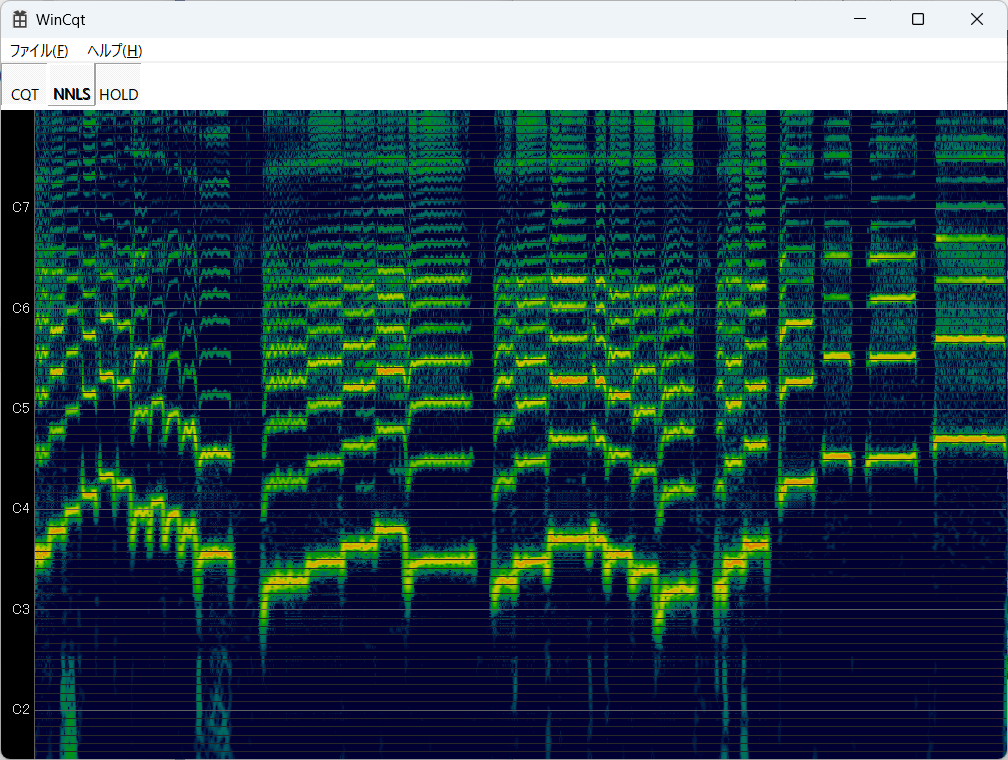
また、ピッチクラス化前のスペクトル( (d)と(e) )を比べると、(e)のCQTの結果では高域が倍音により密になっているのに比べて、(d)のNNLS Chromaでは低域から高域まで疎な音で構成されているのが分かる。
は 下三角行列(対角要素は正)
は